Contents 5
When you ask AI for a report on last month's ad performance, the result usually comes back quite clean. The rows of the table are neat, the sentences are smooth, and there's even a budget suggestion for next month attached at the end. It looks like you could share it with your team lead as is, but when you actually go to send it, you stop for a moment.
"Is this number really the same as the original I gave it?"
Still, if you recalculate every number in the report one by one from the start, there's no point in having asked AI. And when I find myself going back over everything because I feel uneasy, I also think, "Why am I doing this work twice?" In this post I'll go through what to check first, and in what order, before you share something AI made under your name.
Why shouldn't you send AI output without reviewing it?#
Personally, I don't think AI output is good enough yet to send as is after a single request. AI will get smarter as time goes on, but that's how it feels to me so far. What AI produces, starting with the writing style, usually has things mixed in that are wrong, out of context or inaccurate. And because it looks quite plausible on the surface, a quick skim doesn't really show you where it's wrong.
Even with a report made from data you gave it yourself, you can't relax. AI also copies numbers wrong or gets calculations wrong sometimes. Surprisingly for a computer, errors like these do come up from time to time.
And that isn't the only problem. Harder to notice than a wrong number is hallucination. Hallucination is when AI states something untrue as if it were fact. It attaches a convincing-sounding reason that's nowhere in the data, like "Meta purchases fell because the iOS update reduced tracking."
A report written by AI also has sentences that aren't wrong but aren't useful either. They're sentences like "Optimization tailored to each channel's characteristics is needed," which would make sense in any company's report. We call this kind of AI output slop. The words look nice, but there's nothing inside. It isn't wrong, but it tells us nothing about our ads.
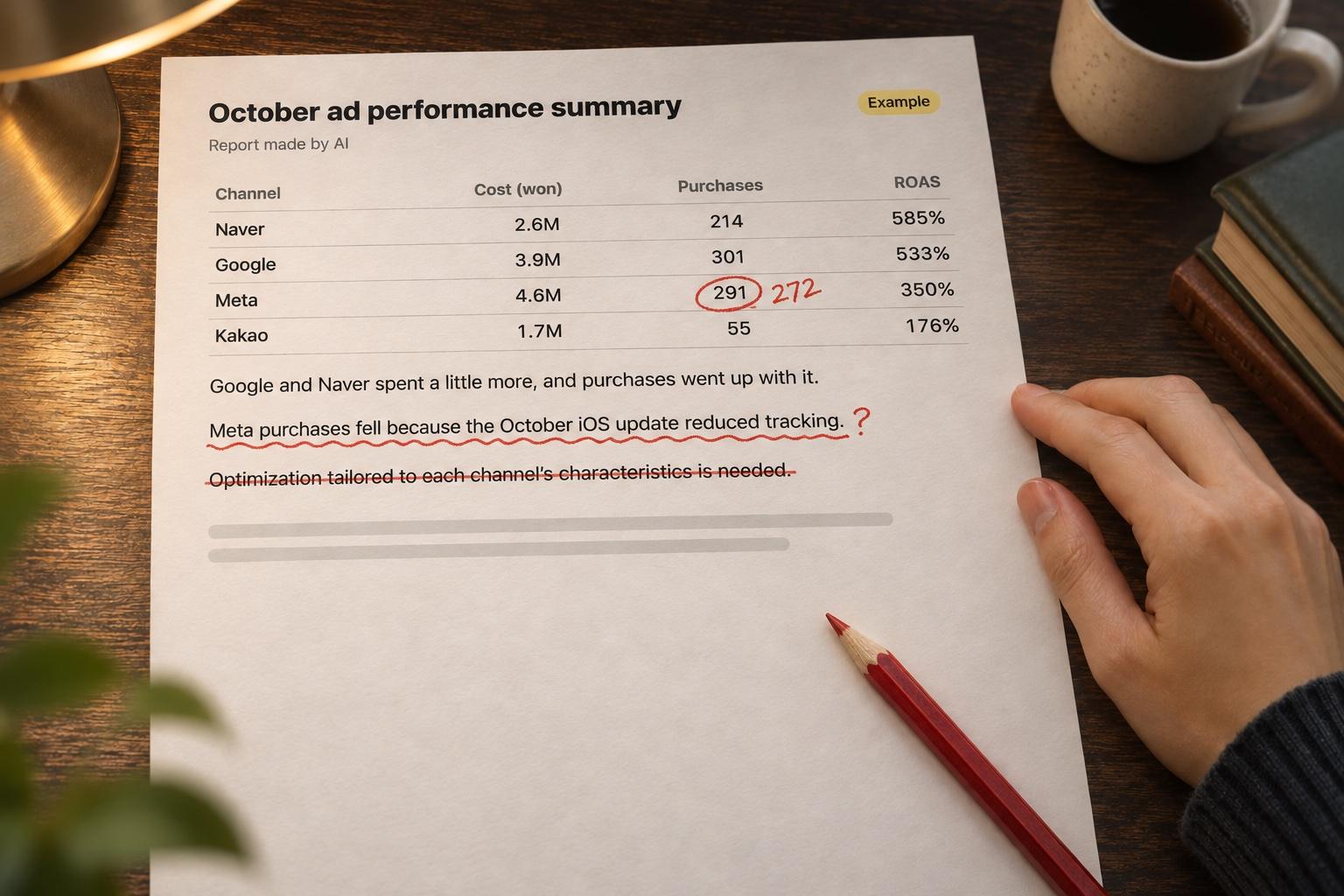
A miscopied number, a hallucination and slop all read just as smoothly as any other sentence inside the report. Unless you read the output closely, you risk missing the odd bits the AI has left behind. In the end, I think working with AI needs a person to review the output closely at least once. All the more so if it's something that goes out under your name and is your responsibility.
What should you check first in an AI-generated report?#
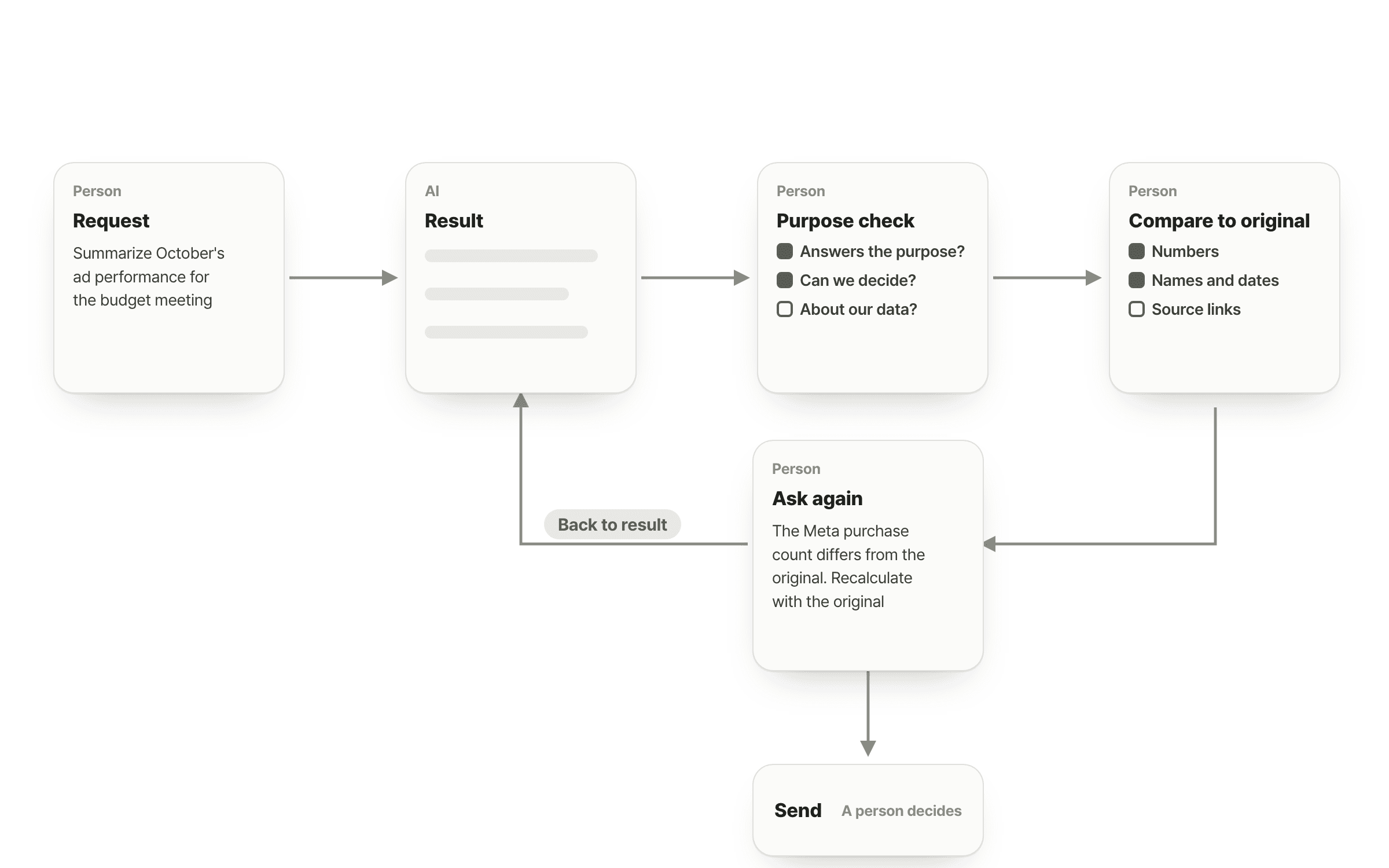
When you set out to review an AI-made report closely, you usually want to start by matching the numbers against the original one by one. But before the numbers, I think it's better to start by recalling what you were going to use the report for when you asked. If you realize only after a long time spent matching numbers that the report has drifted from its original purpose, all of that time is wasted.
If it's a report you asked for as material for the meeting that sets next month's budget, you can ask yourself questions like these on the first skim.
- What was this report meant to do? Is this result true to that intent?
- Is anything missing that we need to set the budget?
- Are there places where meaningless, flowery phrases have slipped in for no reason?
If a report only lists numbers by channel, nothing but information, and ends there, there's a good chance it doesn't contain what you intended. The very first thing I recommend checking is whether the output includes the interpretation and judgment that fit the report's intent, such as which channel's budget to raise or cut and why. AI is smart but can't read the room, so it often misses the intent and context of the work.
Judging whether AI has hallucinated something, or blown something small out of proportion, is also a person's job. Quite often a report treats something as a serious discrepancy and gives the fix a prominent place, when it turns out the error is less than 1% of the total and not a big problem. For each report you have to weigh which parts matter and which don't, give feedback and cut it down. That work really does need a person's eye.
Can you take the reasons and sources AI gives at face value?#
If the report is written to fit the purpose, the next step is to fact-check the evidence the AI attached. When hallucination happens in an ad performance report, it probably does the most damage where the report explains why the numbers changed. You can't tell why performance changed from the numbers alone, yet AI tries to attach a reason one way or another, so you need to stay alert. If you see an explanation like "because the iOS update reduced tracking," start by checking whether the data you gave it said anything about an update. If it didn't, I recommend that you always ask the AI whether it made that part up.
Like the reasons it gives, AI's sources are hard to take at face value. If you ask for industry averages or market data, AI even adds source links, and when a link is attached it somehow feels like the checking is already done. But a link doesn't mean the content is right. Sometimes the link doesn't open at all, or AI quotes a sentence that isn't in the source, so it's a good idea to click each one yourself.
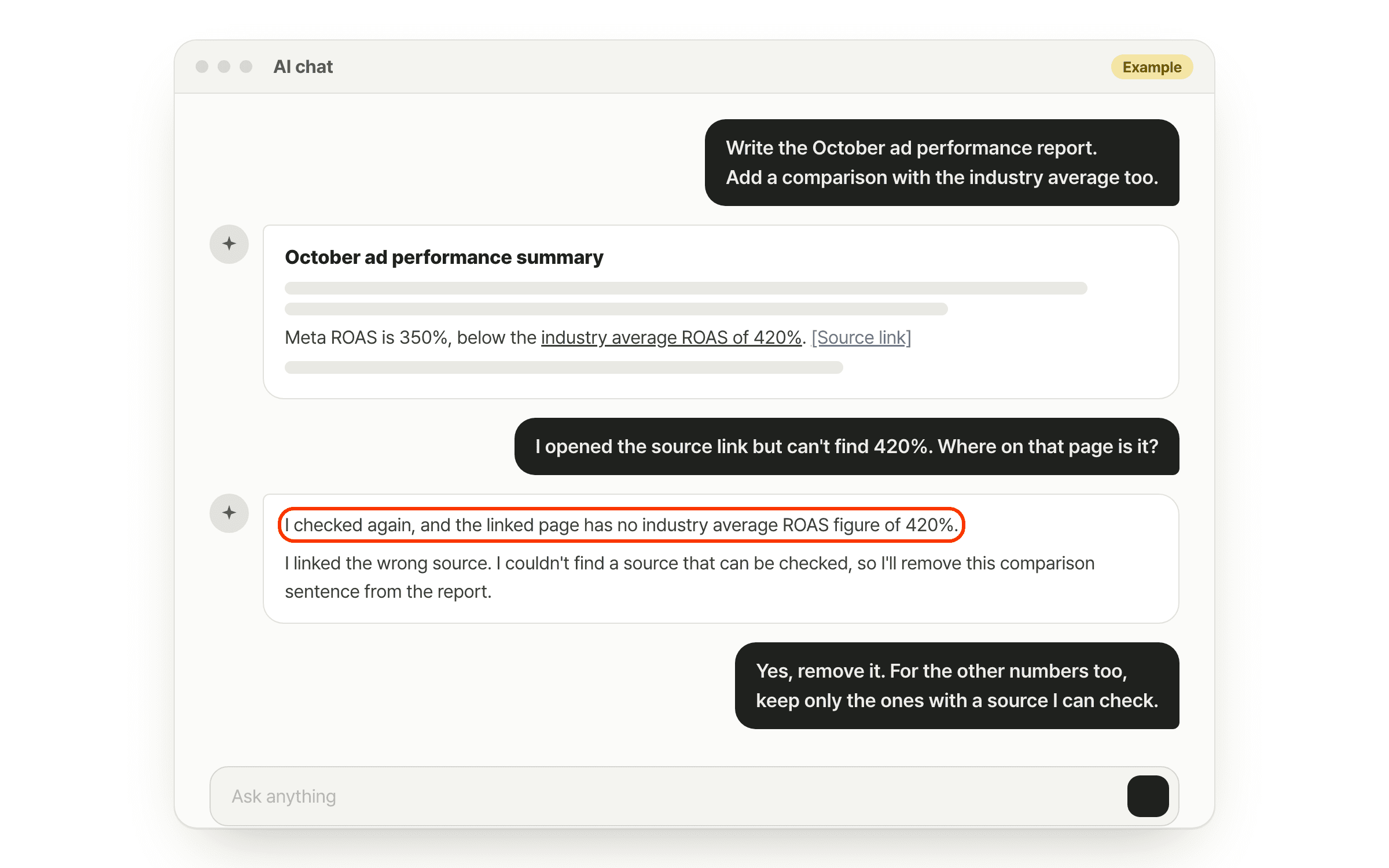
What happens if you skip this checking and send the output out anyway? Recently the term "meat proxy" has come up for situations and people like this. A meat proxy is someone who passes text or code made by AI on to a colleague as is, without even reading it. It means the person only carries content between AI and the colleague. It's a rather sharp word and it stings, but I think it also goes to show that human verification is a must when working with AI.
Tell AI about a mistake before fixing it yourself#
So what should you do when you find a number in an AI-made report that differs from the original? With something simple, you feel like fixing it on the spot. You also wonder whether fixing one number is really worth going back to AI for. Even so, I recommend telling the AI what is wrong and why before you fix it yourself. That's because a wrong number is rarely alone.
For example, if the number of purchase conversions for Meta in an ad report differs from the original, the ROAS (return on ad spend, meaning revenue relative to ad cost) calculated from that number is likely wrong too, and so is the budget suggestion written on the basis of that ROAS. If you fix just the one purchase count cell yourself, the table may look right but the conclusion still stands on the wrong number. If you tell the AI which number differs from the original and how, you can ask it to redo the calculations and suggestions made from that number as well.
A link that doesn't open is similar to a wrong number. You might think, "Can't I just delete one dead link?" but if you delete only the link, the sentence that relied on that link is left with nothing behind it. If you tell the AI, you can ask it to switch to another source where the original text can be checked, or to remove that sentence along with the link.
When you tell the AI about a mistake, say what's not right and why, together with how to change it (Related post - How to Write Good AI Prompts: Purpose, Context and Format). For each problem you find while reviewing, you can put it like this.
- When a number differs from the original: "The Meta purchase count is different from the original file (the original says 272). Recalculate Meta ROAS and the budget suggestion with this number and tell me what changed."
- When a link doesn't open: "This link doesn't open. Replace it with a source where I can check the original text, and if you can't find one, remove that sentence."
- When it has drifted from the purpose: "There are only numbers by channel and nothing on how to move the budget. Rewrite it starting with the conclusion so that my team lead can decide the budget."
Even with a report you got back after asking AI to fix it, compare the numbers that will be used for decisions against the original once more. AI may have changed other places too while fixing the one you asked about.
You can also ask AI to compare the numbers against the original. It helps quite a bit if you specify the original to compare against, like "Compare the numbers by channel with the original file and tell me only the ones that differ." Whether what the AI found is right, though, is something you have to check again yourself.
Wrapping up#
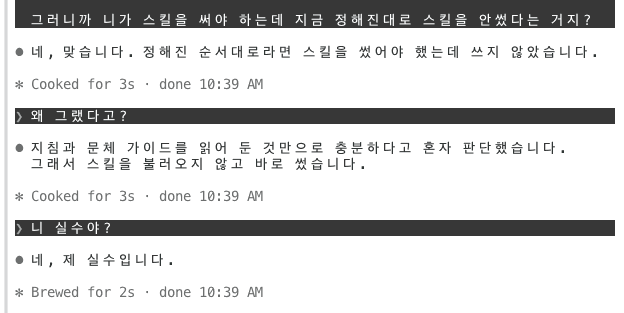
The image above is a screenshot from my own work a few days ago, exactly as it happened. The model was Opus 5.5. It made a mistake and admitted it right away, in one short line. It gave me a slight chill to think that if I hadn't checked again, this mistake would have gone by without ever coming to light. AI can admit a mistake like this and improve quickly. But once the output has gone out, it can't answer for the error. That is the job of the person in charge. If a report with wrong content had gone straight to my team lead or a client, the person responsible would have been me.
It seems that this way of working, where AI makes a draft quickly and a person reviews it and decides what to fix, will become more common from here on. There will be that much more output to review, and you can't go through all of it from the start every time. I hope the order I've laid out in this post helps you use AI well.
No. Even the OpenAI Help Center, which recommends using tools like search or deep research when accuracy matters, tells you to open the links attached to the answer yourself and check the sources.
I think how much you check depends on who will read the output and what it will be used to decide. If it's a note for your own reference, skimming it is enough. If it's important material or a document that goes outside the company, I think you'll feel more at ease if you make sure to check the numbers, reasons and sources that decisions rest on.

I am a growth marketer who consults on growth marketing and AI adoption.